
Men’s Therapy in Los Angeles

Men’s Therapist in West Los Angeles
Build Confidence
Strengthen Relationships
Create Meaningful Change
Men often come to therapy not because they are falling apart, but because something important is no longer working.
You may be successful in your career, responsible for others, and high functioning in many areas of life while privately struggling with anxiety, relationship problems, anger, self doubt, emotional disconnection, career pressure, or a loss of direction.
Maybe you have learned how to push through challenges, solve problems, stay productive, and keep moving forward. From the outside, you may appear confident and capable. Internally, however, you may feel overwhelmed, frustrated, disconnected, or exhausted from carrying everything on your own.
Therapy can provide a place to understand what is happening beneath the surface and begin making meaningful changes.
I'm Todd Deutsch, LMFT, a men’s therapist in Los Angeles and founder of Complete Game Plan. I have more than 20 years of experience working with men, couples, professionals, fathers, executives, entrepreneurs, athletes, and individuals navigating personal, professional, and relationship challenges.
I provide men’s therapy in West Los Angeles, along with online therapy for men throughout California.
Why Men Come to Therapy
Men seek therapy for many different reasons. Some are struggling with anxiety, stress, anger, depression, or low confidence. Others come because a relationship is struggling, work has become overwhelming, or they simply do not feel like themselves anymore.
You may be experiencing:
Anxiety, overthinking, or constant internal pressure
Relationship conflict or emotional distance
Difficulty communicating what you feel or need
Anger, irritability, or emotional shutdown
Low confidence or persistent self doubt
Career stress, burnout, or loss of motivation
Perfectionism or fear of failure
Difficulty with vulnerability, trust, or intimacy
Separation, divorce, or relationship transitions
Fatherhood and family pressure
Questions about identity, purpose, or direction
Men’s therapy is not about becoming someone different. It is about understanding yourself more clearly, recognizing patterns that may be limiting you, and developing healthier ways of responding to stress, relationships, emotions, and everyday life.
Strength Does Not Mean Doing Everything Alone
Many men grow up with strong messages about what strength is supposed to look like: stay in control, solve the problem, be independent, and keep moving.
Those qualities can be tremendous strengths. The difficulty begins when strength becomes the belief that you should never need support, never feel uncertain, or never let anyone see what you are struggling with.
Emotions that are repeatedly pushed aside may eventually show up as anxiety, anger, irritability, withdrawal, perfectionism, overworking, relationship conflict, or emotional distance.
Men’s mental health is not about abandoning strength. It is about expanding what strength can include: self-awareness, communication, boundaries, emotional regulation, and the willingness to address something when it is not working.
Relationships, Attachment, and Emotional Connection
Relationships are one of the most common reasons men begin therapy.
You may love your partner deeply yet find yourself caught in the same arguments. You might shut down during conflict, become defensive when you feel criticized, struggle to explain what you are feeling, or withdraw when conversations become emotionally intense.
Attachment patterns can influence how we respond to closeness, rejection, conflict, and vulnerability. Some men become anxious when they sense distance. Others protect themselves by becoming more emotionally independent or shutting down. Some move between both reactions.
Understanding these patterns is not about labeling yourself. It is about recognizing what happens inside you when you feel criticized, rejected, misunderstood, or emotionally exposed.
Therapy can help you slow those patterns down, communicate more clearly, stay present during difficult conversations, and build healthier emotional connection.
A Different Way of Thinking About Vulnerability
Healthy vulnerability does not mean telling everyone everything or abandoning your boundaries.
It means being able to communicate honestly while remaining grounded in yourself.
Sometimes that means being able to say:
This hurt me.
I'm worried.
I need something.
I made a mistake.
I care about this relationship.
Openness and strength do not have to compete with one another. You can have both.
Anger, Anxiety, and Emotional Shutdown
Anger is often the emotion people notice first, but it is not always the entire story.
Underneath anger may be disappointment, fear, embarrassment, shame, hurt, rejection, exhaustion, or feeling powerless.
Other men respond to stress by shutting down. Anxiety can also show up less obviously through irritability, perfectionism, difficulty sleeping, overthinking, workaholism, fear of disappointing others, or a strong need to remain in control.
Therapy can help you recognize what activates these reactions, understand what is happening beneath them, regulate your nervous system, and respond with greater clarity instead of reacting automatically.

Therapy for High-Functioning Men and Professionals
A significant part of my work involves therapy for high-functioning men, professionals, leaders, executives, and entrepreneurs.
You may have built a successful career, business, family, or reputation while still feeling that parts of your life are not where you want them to be.
High-functioning men are often very skilled at managing external demands. But some of the same habits that support professional success can create difficulties personally.
You may:
Have difficulty turning your mind off
Measure your value by productivity or achievement
Put enormous pressure on yourself to perform
Overanalyze decisions
Avoid emotionally uncomfortable conversations
Feel confident professionally but uncertain in relationships
Fear disappointing the people who depend on you
Success does not automatically eliminate self doubt.
Therapy can help separate identity from performance and develop a more grounded form of confidence.
Confidence does not mean believing you will never fail. It means trusting yourself to respond to what happens next.
Career Pressure, Burnout, and Life Direction
Career success does not always create fulfillment.
You may have accomplished goals you worked toward for years and still wonder what comes next. Maybe work has become exhausting, motivation has changed, or your relationships and personal life have received less attention along the way.
Therapy can create space to step outside the momentum of everyday life and ask:
What matters to me now?
What am I working toward?
Where am I out of balance?
What kind of life do I actually want to build?
Meaningful change does not always require abandoning what you have created. Sometimes it means becoming more intentional about how you want to live within it.
Fatherhood and Family
Fatherhood can be one of the most meaningful experiences in a man’s life while also bringing tremendous responsibility and pressure.
You may be balancing career demands, relationships, finances, parenting, and your own emotional needs at the same time. You may question whether you are being a good father, recognize patterns from your own childhood that you do not want to repeat, or feel responsible for everyone while making very little room for yourself.
Therapy can provide a place to explore your role as a father while also making room for the person behind that role.
My Approach to Men’s Therapy
I do not believe there is one way therapy should look for every man.
Some men want to better understand how earlier experiences, family dynamics, or relationships shaped who they are today. Others are focused on solving something happening right now. Many benefit from both.
My approach is collaborative and may integrate psychodynamic therapy, cognitive behavioral strategies, attachment-based work, mindfulness, narrative therapy, emotional regulation, and practical problem solving, depending on the individual and what we are working toward.
Our work may focus on:
Relationships and attachment
Communication and conflict
Anxiety and overthinking
Confidence and self doubt
Anger and emotional regulation
Career and leadership pressure
Fatherhood and family relationships
Major decisions and life transitions
Therapy should feel relevant to your life, your relationships, your goals, and the changes you want to make.
You Do Not Have to Be in Crisis to Begin Therapy
Therapy is not only for moments when everything has fallen apart.
Some men begin because they are struggling significantly. Others begin because they recognize a pattern they want to change before it creates a larger problem.
You may want to become a better partner, a more connected father, a more confident leader, less reactive, less anxious, or simply more intentional about how you want to live.
Therapy can be a place to address problems, but it can also be a place for growth, self-understanding, and meaningful change.
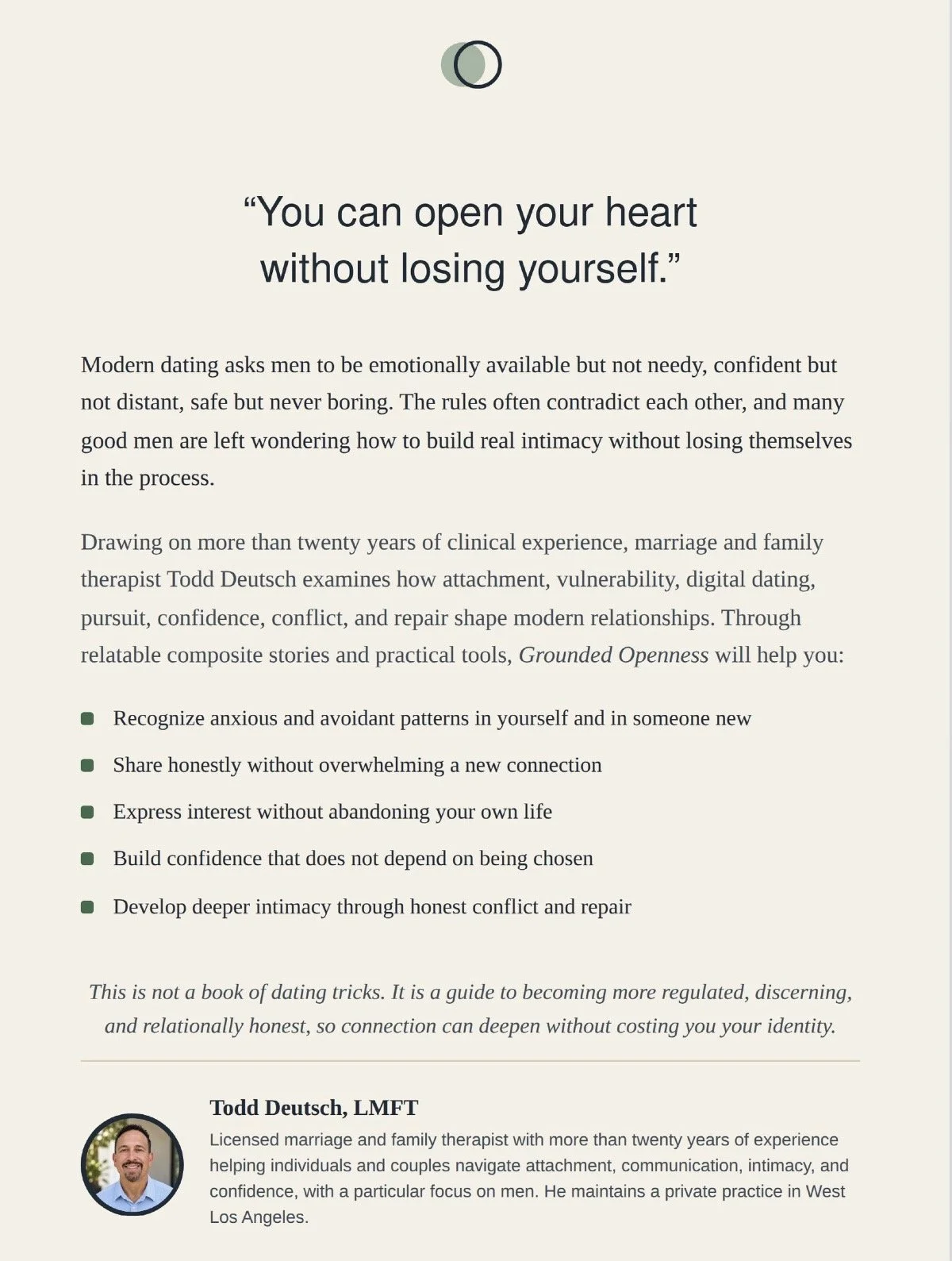
Grounded Openness
Much of my work around men, relationships, attachment, emotional regulation, and vulnerability is also explored in my book, Grounded Openness: Attachment, Attraction, and Staying Yourself in Modern Relationships.
The book explores how men can become more emotionally available without losing confidence, independence, identity, or a sense of self.
At the center of the book is a principle that also informs much of my work with men:
You can open your heart without losing yourself
Learn More About Grounded Openness
Read the Book Free
Men’s Therapist in West Los Angeles
Complete Game Plan provides men’s therapy in West Los Angeles for clients throughout the Los Angeles area, including Century City, Westwood, Beverly Hills, Culver City, and surrounding communities.
Online therapy is also available throughout California.
Whether you are looking for a men’s therapist because of anxiety, relationship difficulties, anger, career pressure, confidence, fatherhood, emotional disconnection, or simply feeling stuck, therapy can give you a place to better understand what is happening and decide how you want to move forward.
Not Sure Where to Start? Let’s Chat
I offer a complimentary 10–15 minute introductory call so we can briefly connect before scheduling a first session.
It is an opportunity to tell me a little about what you are looking for, learn how I work, and ask any questions you may have.
Ready to take the first step?
Schedule a Complimentary Consultation
You do not need to have everything figured out before reaching out. Sometimes the first step is simply recognizing that the way things are working now is not the way you want them to continue.